⚖️ AVL Tree
Introduction
The AVL Tree library offers an efficient on-chain solution for managing balanced binary search trees. Designed to maintain self-balancing height properties, the AVL Tree ensures that operations such as insertions, deletions, and lookups can be performed in logarithmic time. It also offers the flexibility to set a custom comparator function, that will be used to build the tree.
Implementation
The AvlTree library is structured to handle three types of values: uint256, bytes32, and address, each facilitating different use cases. Every node in the AVL tree has a bytes32 key, allowing for the storage of different data types as keys.
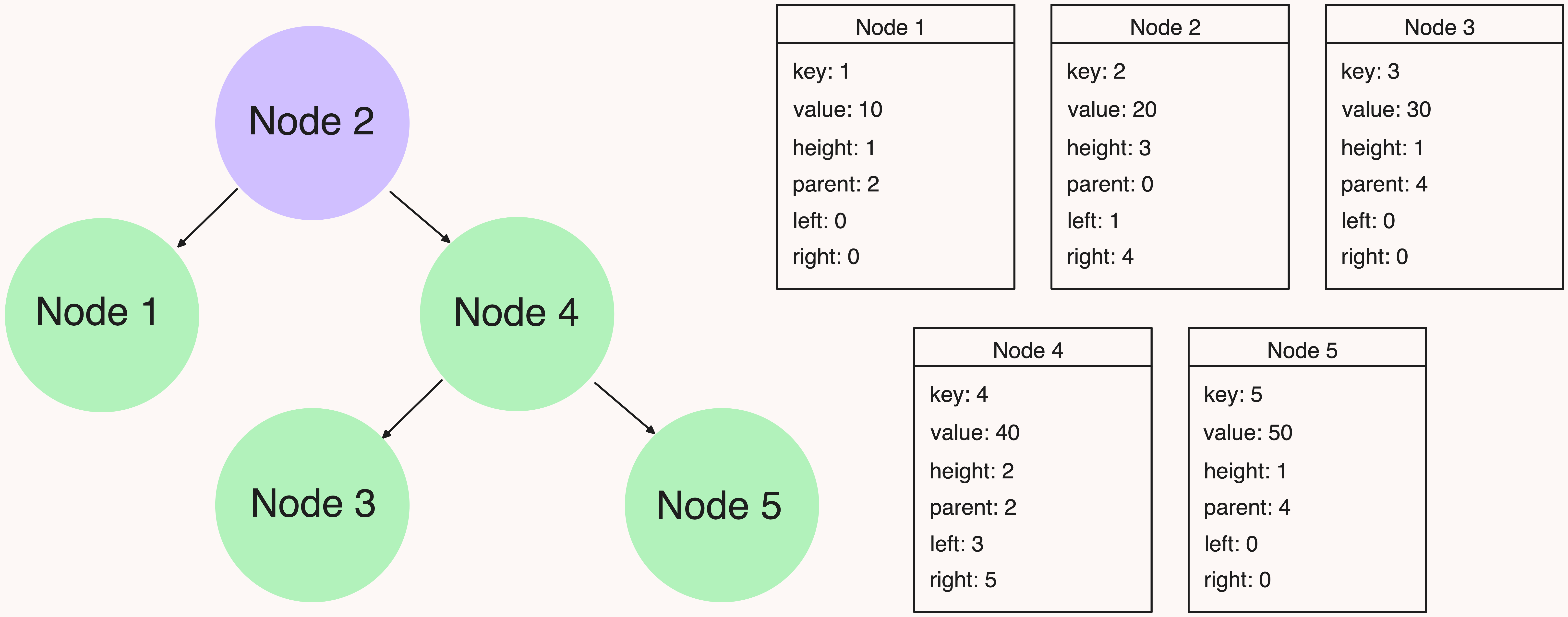
The tree is simply a mapping of keys to nodes. Thanks to the structure of node which provides the parent node reference the iterative traversal of the tree is possible.The example below shows how the nodes are represented in the tree.
Functions
To use the AvlTree contract, you need to import it.
import "@solarity/solidity-lib/libs/data-structures/AvlTree.sol";
And optionally bind it to the type with the using statement.
using AvlTree for AvlTree.UintAVL;
using AvlTree for AvlTree.Bytes32AVL;
using AvlTree for AvlTree.AddressAVL;
setComparator
function setComparator(
    UintAVL storage tree,
    function(bytes32, bytes32) view returns (int256) comparator_
) internal;
function setComparator(
    Bytes32AVL storage tree,
    function(bytes32, bytes32) view returns (int256) comparator_
) internal;
function setComparator(
    AddressAVL storage tree,
    function(bytes32, bytes32) view returns (int256) comparator_
) internal;
Description
This function sets a custom comparator function to be used for Avl Tree construction. The comparator function takes 2 keys to compare as parameters. It is expected to return 1 if the first element to be compared is greater than the second one, -1 if it is less, 0 if they are equal.
The operation will revert if the tree already contains at least one node.
Time complexity
Constant.
Example
AvlTree.UintAVL public uintTree;

function _descComparator(
    bytes32 key1_,
    bytes32 key2_
) internal pure returns (int256) {
    if (key1_ > key2_) {
        return -1;
    }

    if (key1_ < key2_) {
        return 1;
    }

    return 0;
}

uintTree.setComparator(_descComparator);
insert
function insert(UintAVL storage tree, bytes32 key_, uint256 value_) internal;
function insert(Bytes32AVL storage tree, bytes32 key_, bytes32 value_) internal;
function insert(AddressAVL storage tree, bytes32 key_, address value_) internal;
Description
This function inserts a new node into the tree. The operation will revert if the key is 0 or a node with the key already exists in the tree.
Time complexity
O(log(n)), where n is the number of elements in the tree.
Example
AvlTree.UintAVL public uintTree;

uintTree.insert(bytes32(1), 100);
uintTree.insert(bytes32(2), 200);

uintTree.size(); // 2
remove
function remove(UintAVL storage tree, bytes32 key_) internal;
function remove(Bytes32AVL storage tree, bytes32 key_) internal;
function remove(AddressAVL storage tree, bytes32 key_) internal;
Description
This function removes a new node from the tree. The operation will revert if the key is 0 or a node with the key doesn't exist in the tree.
Time complexity
O(log(n)), where n is the number of elements in the tree.
Example
AvlTree.UintAVL public uintTree;

uintTree.insert(bytes32(1), 100);

uintTree.remove(bytes32(2)); // Reverts with "AvlTree: the node doesn't exist"
uintTree.remove(bytes32(1));

uintTree.size(); // 0
get
function get(UintAVL storage tree, bytes32 key_) internal view returns (uint256);
function get(Bytes32AVL storage tree, bytes32 key_) internal view returns (bytes32);
function get(AddressAVL storage tree, bytes32 key_) internal view returns (address);
Description
This function returns the value of the node with the specified key. The operation will revert if a node with the key doesn't exist in the tree.
Time complexity
O(log(n)), where n is the number of elements in the tree.
Example
AvlTree.UintAVL public uintTree;

uintTree.insert(bytes32(3), 300);

uintTree.get(bytes32(1)); // Reverts with "AvlTree: the node doesn't exist"
uintTree.get(bytes32(3)); // 300
tryGet
function tryGet(UintAVL storage tree, bytes32 key_) internal view returns (bool, uint256);
function tryGet(Bytes32AVL storage tree, bytes32 key_) internal view returns (bool, bytes32);
function tryGet(AddressAVL storage tree, bytes32 key_) internal view returns (bool, address);
Description
This function tries to retrieve the value associated with the specified key. It returns true if node with the key exists, false otherwise, and the value of the node. The operation will not revert if a node with the key doesn't exist in the tree.
Time complexity
O(log(n)), where n is the number of elements in the tree.
Example
AvlTree.UintAVL public uintTree;

uintTree.insert(bytes32(1), 100);

uintTree.tryGet(bytes32(2)); // (false, 0)
uintTree.tryGet(bytes32(1)); // (true, 100)
size
function size(UintAVL storage tree) internal view returns (uint64);
function size(Bytes32AVL storage tree) internal view returns (uint64);
function size(AddressAVL storage tree) internal view returns (uint64);
Description
This function returns the number of elements in the tree.
Time complexity
Constant.
Example
Avltree.UintAVL public uintTree;

uintTree.insert(bytes32(1), 10);
uintTree.insert(bytes32(2), 20);

uintTree.size(); // 2
first
function first(UintAVL storage tree) internal view returns (Traversal.Iterator memory);
function first(Bytes32AVL storage tree) internal view returns (Traversal.Iterator memory);
function first(AddressAVL storage tree) internal view returns (Traversal.Iterator memory);
Description
This function returns the iterator pointing to the first (leftmost) node in the tree. The functions can be utilized for an in-order traversal of the tree.
Time complexity
O(log(n)), where n is the number of elements in the tree.
Example
Avltree.UintAVL public uintTree;

uintTree.insert(bytes32(2), 20);
uintTree.insert(bytes32(1), 10);
uintTree.insert(bytes32(4), 40);

Traversal.Iterator memory iterator_ = uintTree.first();

iterator_..value(); // (bytes32(1), bytes32(10))
last
function last(UintAVL storage tree) internal view returns (Traversal.Iterator memory);
function last(Bytes32AVL storage tree) internal view returns (Traversal.Iterator memory);
function last(AddressAVL storage tree) internal view returns (Traversal.Iterator memory);
Description
This function returns the iterator pointing to the last (rightmost) node in the tree. The functions can be utilized for an in-order backwards traversal of the tree.
Time complexity
O(log(n)), where n is the number of elements in the tree.
Example
Avltree.UintAVL public uintTree;

uintTree.insert(bytes32(2), 20);
uintTree.insert(bytes32(1), 10);
uintTree.insert(bytes32(4), 40);

Traversal.Iterator memory iterator_ = uintTree.last();

iterator_..value(); // (bytes32(4), bytes32(40))
isCustomComparatorSet
function isCustomComparatorSet(UintAVL storage tree) internal view returns (bool);
function isCustomComparatorSet(Bytes32AVL storage tree) internal view returns (bool);
function isCustomComparatorSet(AddressAVL storage tree) internal view returns (bool);
Description
This function returns true, if the custom comparator function was set, and false otherwise.
Time complexity
Constant.
Example
AvlTree.UintAVL public uintTree;

function _descComparator(
    bytes32 key1_,
    bytes32 key2_
) internal pure returns (int256) {
    if (key1_ > key2_) {
        return -1;
    }

    if (key1_ < key2_) {
        return 1;
    }

    return 0;
}

uintTree.isCustomComparatorSet(); // false

uintTree.setComparator(_descComparator);

uintTree.isCustomComparatorSet(); // true
🛤 Traversal
Introduction
The Traversal library allows for in-order traversal of an AVL tree in Solidity. It provides various functions for iterating through the tree in different directions, checking for the existence of the next or previous node, and retrieving node values.
Implementation
The iterative traversal is possible because each node in the AVL tree maintains a reference to its parent node. This parent reference allows the traversal algorithm to efficiently move up and down the tree structure without the need for recursive calls, which can be both resource-intensive and prone to stack overflow issues in deep trees.
The library also enhances gas efficiency and execution speed by leveraging inline assembly for direct storage access, rather than passing the entire tree to each function. This is achieved by storing the treeMappingSlot field in the Iterator struct.
Example
import {AvlTree, Traversal} from "@solarity/solidity-lib/libs/data-structures/AvlTree.sol";

using AvlTree for AvlTree.UintAVL;
using Traversal for Traversal.Iterator;

Avltree.UintAVL public uintTree;

uintTree.insert(bytes32(2), 20);
uintTree.insert(bytes32(1), 10);
uintTree.insert(bytes32(4), 40);

bytes32[] memory keys_ = new bytes32[](uintTree.size());
bytes32[] memory values_ = new bytes32[](uintTree.size());

uint256 index_;

while (iterator_.isValid()) {
    (keys_[index_], values_[index_]) = iterator_.value();

    iterator_.next();

    index_++;
}

// keys_.asUint256Array(): [1, 2, 3]
// values_.asUint256Array(): [10, 20, 30]