🌳 Priority Queue
Introduction
This Priority Queue offers a way to manage elements in a sequence based on their priority, ensuring that higher priority elements are processed first. This functionality is crucial in various applications, such as priority-based withdrawals or purchases, where users with higher stakes or urgency might need faster processing. Additionally, it's instrumental in reputation-based systems, where actions or rewards are determined by a user's standing.
Implementation
The Priority Queue follows the structure of a complete binary heap that fulfills the property: each node is higher in priority than its children. In this setup, the highest priority element is always at the top of the heap.
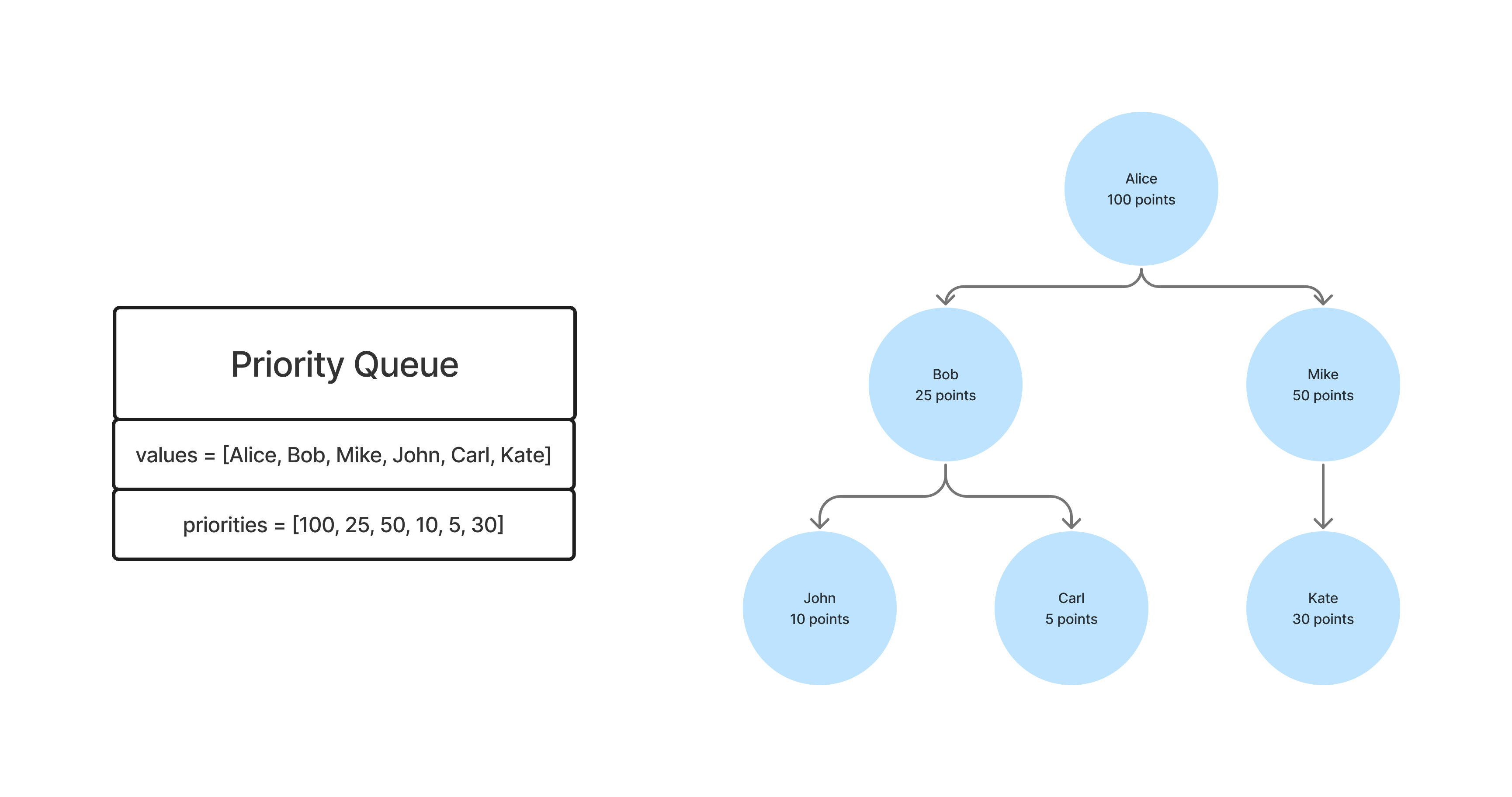
As elements are added to the Priority Queue, they are initially placed at the bottom of the heap. This step is followed by a shift up process, where the added element is compared with its parent node and swapped if its priority is higher. This is repeated until the new element is properly positioned, ensuring that the heap's property is maintained. The efficiency of adding elements lies in the fact that the number of comparisons and potential swaps is proportional to the height of the heap, which is logarithmic in relation to the number of stored elements.
The interaction with the Priority Queue also involves operations of accessing and removing the highest priority element. Once this top element is removed, the heap must be restructured to find the next highest priority element. This is done through a shift down process. In this process, the last element in the heap is temporarily moved to the top and then iteratively shifted down the heap. At each iteration, it is compared with its child nodes, and if a child node has a higher priority, a swap is made. This process continues until the temporary top element finds its correct position in the heap, thus restoring the heap property.
It's important to note that while this Priority Queue guarantees access to the highest priority element, the overall order of elements is not guaranteed.
Functions
To use the PriorityQueue library, you need to import it.
import "@solarity/solidity-lib/libs/data-structures/PriorityQueue.sol";
And optionally bind it to the type with the using statement.
using PriorityQueue for PriorityQueue.UintQueue;
using PriorityQueue for PriorityQueue.AddressQueue;
using PriorityQueue for PriorityQueue.Bytes32Queue;
add
function add(UintQueue storage queue, uint256 value_, uint256 priority_) internal;
function add(Bytes32Queue storage queue, bytes32 value_, uint256 priority_) internal;
function add(AddressQueue storage queue, address value_, uint256 priority_) internal;
Description
This function adds new elements to the queue. It balances the inner heap, placing the value_ in its correct position based on its priority_.
Time complexity
O(log(n)), where n is the length of the queue.
Example
PriorityQueue.AddressQueue public queue;

address alice_ = address(1);
address bob_ = address(2);
address john_ = address(3);

queue.add(alice_, 3); // [alice_:3]
queue.add(bob_, 10);  // [bob_:10, alice_:3]
queue.add(john_, 5);  // [bob_:10, john_:5, alice_:3]
removeTop
function removeTop(UintQueue storage queue) internal;
function removeTop(Bytes32Queue storage queue) internal;
function removeTop(AddressQueue storage queue) internal;
Description
This function removes the element with the highest priority from the queue. It balances the inner heap after removal. It will revert if called on an empty queue.
Time complexity
O(log(n)), where n is the length of the queue.
Example
PriorityQueue.AddressQueue public queue;

address alice_ = address(1);
address bob_ = address(2);
address john_ = address(3);

queue.add(alice_, 3); // [alice_:3]
queue.add(bob_, 10);  // [bob_:10, alice_:3]
queue.add(john_, 5);  // [bob_:10, john_:5, alice_:3]

queue.removeTop();    // [john_:5, alice_:3]
queue.removeTop();    // [alice_:3]
queue.removeTop();    // []
queue.removeTop();    // Reverts with: "PriorityQueue: empty queue"
topValue
function topValue(UintQueue storage queue) internal view returns (uint256);
function topValue(Bytes32Queue storage queue) internal view returns (bytes32);
function topValue(AddressQueue storage queue) internal view returns (address);
Description
This function returns the value of the element with the highest priority in the queue. It is a read-only function. It will revert if called on an empty queue.
Time complexity
Constant.
Example
PriorityQueue.AddressQueue public queue;

address alice_ = address(1);
address bob_ = address(2);

queue.add(alice_, 3); // [alice_:3]
queue.topValue();     // address(1)

queue.add(bob_, 10);  // [bob_:10, alice_:3]
queue.topValue();     // address(2)

queue.removeTop();    // [alice_:3]
queue.topValue();     // address(1)

queue.removeTop();    // []
queue.topValue();     // Reverts with: "PriorityQueue: empty queue"
top
function top(UintQueue storage queue) internal view returns (uint256, uint256);
function top(Bytes32Queue storage queue) internal view returns (bytes32, uint256);
function top(AddressQueue storage queue) internal view returns (address, uint256);
Description
This function returns the value and priority of the element with the highest priority in the queue. It is a read-only function. It will revert if called on an empty queue.
Time complexity
Constant.
Example
PriorityQueue.AddressQueue public queue;

address alice_ = address(1);
address bob_ = address(2);

queue.add(alice_, 3); // [alice_:3]
queue.top();          // (address(1), 3)

queue.add(bob_, 10);  // [bob_:10, alice_:3]
queue.top();          // (address(2), 10)

queue.removeTop();    // [alice_:3]
queue.top();          // (address(1), 3)

queue.removeTop();    // []
queue.top();          // Reverts with: "PriorityQueue: empty queue"
length
function length(UintQueue storage queue) internal view returns (uint256);
function length(Bytes32Queue storage queue) internal view returns (uint256);
function length(AddressQueue storage queue) internal view returns (uint256);
Description
This function returns the number of elements of the queue. It's a read-only function.
Time complexity
Constant.
Example
PriorityQueue.AddressQueue public queue;

address alice_ = address(1);
address bob_ = address(2);

queue.add(alice_, 3); // [alice_:3]
queue.length();       // 1

queue.add(bob_, 10);  // [bob_:10, alice_:3]
queue.length();       // 2

queue.removeTop();    // [alice_:3]
queue.length();       // 1

queue.removeTop();    // []
queue.length();       // 0
values
function values(
    UintQueue storage queue
) internal view returns (uint256[] memory values_);
function values(
    Bytes32Queue storage queue
) internal view returns (bytes32[] memory values_);
function values(
    AddressQueue storage queue
) internal view returns (address[] memory values_);
Description
This function returns all the values_ stored in the queue in any order. Exercise caution when calling on large queues due to potential high gas consumptions. It is a read-only function.
Time complexity
O(n), where n is the length of the queue.
Example
PriorityQueue.AddressQueue public queue;

address alice_ = address(1);
address bob_ = address(2);
address john_ = address(3);

queue.add(alice_, 3); // [alice_:3]
queue.add(bob_, 10);  // [bob_:10, alice_:3]
queue.add(john_, 20); // [john_:20, bob_:10, alice_:3]

queue.values(); // [address(3), address(1), address(2)]
elements
function elements(
    UintQueue storage queue
) internal view returns (uint256[] memory values_, uint256[] memory priorities_);
function elements(
    Bytes32Queue storage queue
) internal view returns (bytes32[] memory values_, uint256[] memory priorities_);
function elements(
    AddressQueue storage queue
) internal view returns (address[] memory values_, uint256[] memory priorities_);
Description
This function returns all the values_ and their corresponding priorities_ stored in the queue in any order. Exercise caution when calling on large queues due to potential high gas consumptions. It is a read-only function.
Time complexity
O(n), where n is the length of the queue.
Example
PriorityQueue.AddressQueue public queue;

address alice_ = address(1);
address bob_ = address(2);
address john_ = address(3);

queue.add(alice_, 3); // [alice_:3]
queue.add(bob_, 10);  // [bob_:10, alice_:3]
queue.add(john_, 20); // [john_:20, bob_:10, alice_:3]

queue.values(); // ([address(3), address(1), address(2)], [20, 3, 10])