➕ Incremental Merkle Tree
Introduction
The Incremental Merkle Tree library provides a cost-effective and straightforward method for maintaining the Merkle Tree data structure on-chain, including the capability to retrieve its root at the contract level. It also offers the flexibility to set a custom hash function, such as the Poseidon hash function, to make it ZKP-friendly. It has been implemented following the analysis of the Deposit Contract Verification.
Implementation
The IncrementalMerkleTree library uses two main components: branches, a minimal set of subtree hashes for root calculations, and leavesCount, to keep track of the number of elements. This setup enables the on-chain computation of the root with logarithmic complexity. However, due to its minimalist design, generating a Merkle proof on-chain is not supported, as it requires the whole tree to be stored.
In the example below, the tree is nearly full, utilizing all branches. Initially, the root is set to the zero hash (hash(0)), so we start from the rightmost non-zero element, which is the first element in our branches field. Then, we use the second element in the branches array, representing the hash of a subtree. Eventually, we retrieve the tree root hash. Elements in the tree that are used to obtain the tree root are shown in the image below.
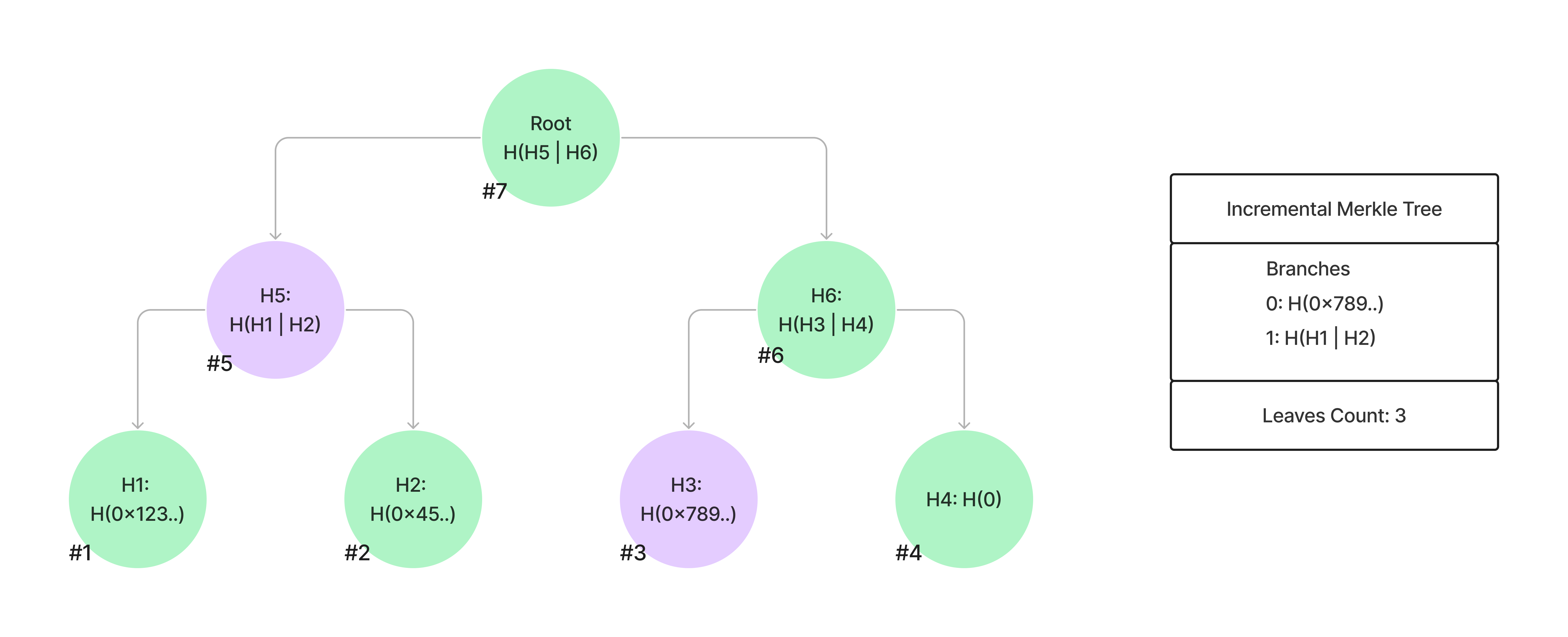
The next attempt to add a new element to the tree will result in tree growth. As we complete a tree with four elements, it will attempt to add the element at index 3 to the branches array. If the array size is insufficient, the element will simply be pushed there.
In general, to retrieve the Merkle Tree Root, we need to iterate over each level of the tree. The leavesCount field determines which pair of elements should be hashed to obtain the parent node hash. The algorithm is as follows:
root: int = zeroHashes[0]
size: int = leavesCount
treeHeight: int = len(branches)
h: int = 0

while h < treeHeight:
    if size % 2 == 1:  # if size is odd
        root = hash(branches[h], root)
    else:              # if size is even
        root = hash(root, zeroHashes[h])
    size //= 2
    h += 1

return root
It is also possible to manually specify the tree height beforehand. The tree height is indicated by the size of the branches array, meaning that if the array length is 40, then the tree size will also be 40.
In cases where the tree is almost full (only one element missing) and its height was set manually, an attempt to complete the tree will cause a revert. To continue using the existing tree, it is possible to resize the tree, making it larger.
The last unique feature of the Incremental Merkle Tree implementation is the ability to set custom hash functions. This is particularly useful when working in a field where a specific hash function must be used due to technical reasons or business logic (e.g., using the Poseidon hash function).
Functions
To use the IncrementalMerkleTree contract, you need to import it.
import "@solarity/solidity-lib/libs/data-structures/IncrementalMerkleTree.sol";
And optionally bind it to the type with the using statement.
using IncrementalMerkleTree for IncrementalMerkleTree.UintIMT;
using IncrementalMerkleTree for IncrementalMerkleTree.Bytes32IMT;
using IncrementalMerkleTree for IncrementalMerkleTree.AddressIMT;
setHeight
function setHeight(UintIMT storage tree, uint256 height_) internal;
function setHeight(Bytes32IMT storage tree, uint256 height_) internal;
function setHeight(AddressIMT storage tree, uint256 height_) internal;
Description
This function sets the height of the Merkle Tree. It reverts if the provided height is less than or equal to the current Merkle Tree height. After the Tree Height is set, it will no longer grow automatically, and its height will have to be adjusted manually.
Time complexity
Constant.
Example
IncrementalMerkleTree.UintIMT public uintTree;

uintTree.setHeight(2);

uintTree.height(); // 2

uintTree.setHeight(1);
// Reverts with
// "IncrementalMerkleTree: the height must be greater than the current one"
add
function add(UintIMT storage tree, uint256 element_) internal;
function add(Bytes32IMT storage tree, bytes32 element_) internal;
function add(AddressIMT storage tree, address element_) internal;
Description
This function adds a new element to the tree. In the case where the tree has (2^n - 1) elements, where (n) is the tree height, the addition of a new element will trigger tree growth.
However, if the tree height was previously set manually, the operation will revert.
Time complexity
O(log(n)), where n is the number of elements in the tree.
Example
IncrementalMerkleTree.UintIMT public uintTree;

uintTree.add(120);

uintTree.height(); // 1

uintTree.add(200);

// Automatic tree growth when the limit of 2^n - 1 is reached
uintTree.height(); // 2
setHashers
function setHashers(
    UintIMT storage tree,
    function(bytes32) view returns (bytes32) hash1_,
    function(bytes32, bytes32) view returns (bytes32) hash2_
) internal;
function setHashers(
    Bytes32IMT storage tree,
    function(bytes32) view returns (bytes32) hash1_,
    function(bytes32, bytes32) view returns (bytes32) hash2_
) internal;
function setHashers(
    AddressIMT storage tree,
    function(bytes32) view returns (bytes32) hash1_,
    function(bytes32, bytes32) view returns (bytes32) hash2_
) internal;
Description
This function sets custom hash functions to be used for Merkle Tree construction. The function will revert if the tree already contains at least one leaf.
Time complexity
Constant.
Example
IncrementalMerkleTree.UintIMT public uintTree;

function _hash1(bytes32 element1_) internal pure returns (bytes32) {
    return bytes32(PoseidonUnit1L.poseidon([uint256(element1_)]));
}

function _hash2(
    bytes32 element1_,
    bytes32 element2_
) internal pure returns (bytes32) {
    return bytes32(
        PoseidonUnit2L.poseidon([uint256(element1_), uint256(element2_)])
    );
}

uintTree.setHashers(_hash1, _hash2);
root
function root(UintIMT storage tree) internal view returns (bytes32);
function root(Bytes32IMT storage tree) internal view returns (bytes32);
function root(AddressIMT storage tree) internal view returns (bytes32);
Description
This function calculates and returns the root of the Merkle Tree based on the elements that were added to the tree previously and the tree's height
Time complexity
O(log(n) + h), where n is the number of elements in the tree and h is the height of the tree.
Example
IncrementalMerkleTree.UintIMT public uintTree;

uintTree.add(1);

uintTree.root(); // keccak256(keccak256(0) . keccak256(1))
height
function height(UintIMT storage tree) internal view returns (uint256);
function height(Bytes32IMT storage tree) internal view returns (uint256);
function height(AddressIMT storage tree) internal view returns (uint256)
Description
This function returns the tree height, which corresponds directly to the length of the branches array.
Time complexity
Constant.
Example
IncrementalMerkleTree.UintIMT public uintTree;

uintTree.add(10);

uintTree.height(); // 1

uintTree.add(200);
uintTree.add(250);
uintTree.add(100);

uintTree.height(); // 3
length
function length(UintIMT storage tree) internal view returns (uint256);
function length(Bytes32IMT storage tree) internal view returns (uint256);
function length(AddressIMT storage tree) internal view returns (uint256);
Description
This function returns the number of leaves that have been added to the Merkle Tree.
Time complexity
Constant.
Example
IncrementalMerkleTree.UintIMT public uintTree;

uintTree.add(10);

uintTree.length(); // 1

uintTree.add(200);
uintTree.add(250);
uintTree.add(100);

uintTree.length(); // 4
isCustomHasherSet
function isCustomHasherSet(UintIMT storage tree) internal view returns (bool);
function isCustomHasherSet(Bytes32IMT storage tree) internal view returns (bool);
function isCustomHasherSet(AddressIMT storage tree) internal view returns (bool);
Description
This function returns true, if the custom hash function was set, and false otherwise.
Time complexity
Constant.
Example
IncrementalMerkleTree.UintIMT public uintTree;

function _hash1(bytes32 element1_) internal pure returns (bytes32) {
    return bytes32(PoseidonUnit1L.poseidon([uint256(element1_)]));
}

function _hash2(
    bytes32 element1_,
    bytes32 element2_
) internal pure returns (bytes32) {
    return bytes32(
        PoseidonUnit2L.poseidon([uint256(element1_), uint256(element2_)])
    );
}

uintTree.isCustomHasherSet(); // false

uintTree.setHashers(_hash1, _hash2);

uintTree.isCustomHasherSet(); // true